
The Ghost Trail and the Lone Wolf: On Seeking What Others Have Forgotten
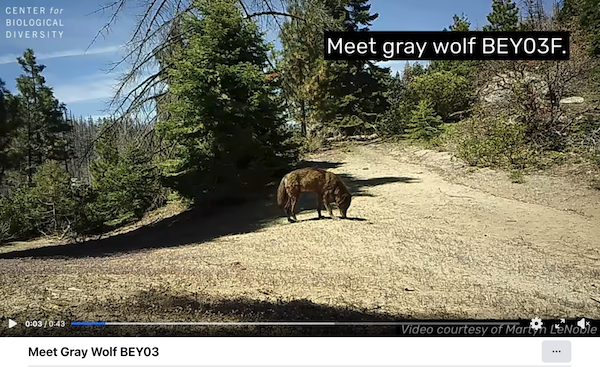
This is a screen shot from a video posted by The Center for Biological Diversity, the video is curtesy of Martyn LeNoble. I snagged this screen shot from a Facebook video. This is Bae, and she has stolen my heart.
In mid-May of 2026, a three-year-old female gray wolf designated BEY03F, affectionately known as Bae, crossed into Sequoia National Park. She is the first wolf to enter this highly protected territory in more than a century. She has entered this place alone after traveling over 1,000 miles since leaving her birthplace in Plumas County, located in the northeastern region of California. Her historic trek has now spanned at least 12 California counties, including a milestone crossing into Los Angeles County, a first for any wolf in over a century. After traversing the rugged Sierra Nevada range, she has most recently been tracked roaming high-altitude terrain inside Sequoia National Park. Her journey will continue until she finds mate.
I am acutely aware of the hundreds and hundreds of miles that already make up Bae’s journey, and I’m aware that there could be hundreds and hundreds more. I know that she has faced incredible challenges including the potential for fatal vehicle collisions on major freeways, death from poaching or livestock conflicts, and the grueling challenge of hunting alone without a pack or mate. At first, this made me sad. My heart aches for Bae. I wonder if she’s sad and lonely. I wonder if she’s going to be okay because I know how perilous her situation is. I can’t help but wonder, what impulse made her leave her pack?
I know there are practical reasons for a wolf to leave their pack. A wolf may leave to find new territory, avoid inbreeding, and to find a mate. Scientists call these wolves “dispersers.” I think of them as the archetypal “lone wolf.” Based on wildlife studies, Bae is classified as an extreme, long-distance disperser because she has traveled over 1,000 miles across the entire state of California, whereas most dispersing wolves typically only travel 50 to 100 miles from their home territory. There is no doubt Bae is currently in her lone wolf era, and I can’t help but wonder how long it will last, and what her journey will reveal — it’s already been so remarkable.
Gray wolves were eradicated from California by 1924 through government sponsored hunting and trapping. The land has been without them for over a hundred years. Does Bae somehow know this? As she takes each step does she consult some wild and primitive wolf history, or better put, ancestral inheritance? Does she calculate the odds of finding her mate as she moves through the ancient sequoia forest? Is she following an instruction, or a deep calling, older than the absence of her kind there? Does she know the landscape still holds the memory of what it once was, and who, wolf or human, once walked there? What does she sense that other wolves don’t? Do other wolves simply not feel call to explore paths not traveled for centuries?
“Ghost trails” is a real term used by trackers and biologists to describe invisible scent highways that wolves naturally follow. These scent trails are central to how wolves survive, find food, and even find mates. I find myself less interested in the conservation story, though it matters, and more interested in what it means to be Bae. To be the one who goes away, the one who leaves the safety of the pack behind. Most wolves stop their journey within 100 miles because they easily find vacant territory or a mate nearby, avoiding the high risks of starvation and injury in unknown lands. Bae has kept moving, she’s had to, because she entered a “ghost zone” completely devoid of other wolves. Driven by a powerful biological instinct to find a partner, she has no choice but to keep walking until she meets another of her kind.
Like the wolves who become dispersers, there is a particular kind of person who enters empty territories. Not because they are reckless or naive, but because something in them orients toward what was, toward what could be, toward a wholeness that exists more as a felt sense than a visible destination. They are followers of ghost trails. I think I might be a lone wolf following the scent of a ghost trail. I feel a kinship to Bae because like her, I’ve have gone places that no one in my family has been. Not in the literal sense of walking hundreds of miles and surviving hand to mouth, in the sense that I feel and know things others don’t. I’ve solo travelled the unseen but deeply felt realms of myself, my soul, and I’ve come to know the traces of my long-gone ancestors. I commune with spirits. I follow their ghost trails. I’ve had to do this alone.
Wolves navigate by scent, by the layered record of who has passed through and when. Bae moving through Sequoia National Park is reading traces that are, at minimum, a hundred years old. She’s following a scent her body knows how to receive even though no living wolf has broadcast it within her lifetime. Something in her remembers. This is the magic of nature, and this is also what seekers do.
We move through landscapes that look empty to the rational eye and follow something faint and old. The creative work with no guaranteed audience. The grief that reaches toward someone gone. The spiritual hunger moving through traditions that have been partially erased, searching for something that we can’t touch. We are always, in some sense, following traces left by those who have disappeared into the spirit realm.
But they aren’t totally gone, they haven’t vanished completely. They’ve just moved into another layer of the territory — the feeling and sensing territory. Some of us are built to navigate this terrain. Some of us here it’s call, feel it’s pull.
The lone wolf is one of our oldest archetypes, and most of its power comes from what we get wrong about it. We assume the lone wolf is a wolf who has lost something, an exile, a castaway. But the lone wolf is more precisely a wolf in transit, in a liminal state that is neither failure nor destination. They engage a particular and necessary kind of movement or journey. The territory itself becomes their teacher. Every landscape entered alone is something becomes something carried in the body, making a lone wolf a specific kind of sacred messenger of time and space. The landscape we as humans enter alone doesn’t look that much different than Bae’s, it may be an internal place rather than an external one, or it might be both.
There is an ache in this. Anyone who has lived it knows. The longing for contact, for recognition, for the other who speaks in a tongue we understand. You enter spaces full of people and feel the specific loneliness of not finding what you came for. The usual gathering places don’t hold what you need. You keep moving.
But ache and curiosity are not opposites. In the lone wolf’s experience they are partners, always present together, one pulling forward and one pulling inward, and the journey happens in the tension between them. To separate them is to flatten the experience into something easier to talk about but no longer true.
I don’t like to think of Bae as lonely or suffering through her journey. She is alive in a way that requires the whole of her. The searching is not a detour from her life. It is her life, happening fully, right now.
Wildlife biologists say she possesses an exceptionally high tolerance for risk and physical endurance, allowing her to cross grueling terrain like the 13,000-foot Sierra Nevada and navigate human-dominated areas like Los Angeles County. She also exhibits remarkable adaptability and social independence, successfully hunting and thriving completely alone across wildly different desert and alpine ecosystems.
I think often about what Bae is doing for the wolves who came before her, and the ones that will come after. The pack that ran in the Sequoia forests before 1924 left something in the land. Their presence shaped the ecosystem in ways that persist even now, in the behavior of deer, in the growth patterns along waterways, in a thousand ecological memories the forest is still carrying. They were eradicated but not entirely erased. The land held them in a different form.
And now Bae moves through that territory, and the land is reading her back. Something is being recognized. Something is being reactivated. Whether she finds a mate in Sequoia or not, she has walked into a place that has been waiting, silently and for a long time, for her to return.
This is what the seeker does for the lineage they move through. The ancestral lines, the creative traditions, the spiritual territories that were damaged or broken or driven underground, they are still here in another form. And when you enter them alone, following something you can’t quite name, you are not lost. You are the continuation. You are the wolf the land has been waiting for.
Bae will keep moving even though she is not likely not find a mate in the Sequoia forest. The wolves are gone from there, and one wolf cannot rebuild what a century of absence has unmade. She may circle back north. She may keep ranging. She may live out her days alone. She will howl at dawn and dusk to broadcast her presence across the wilderness, signaling her location to the mate she searches for. That howl echoes through time eternally. That howl, which I have never heard with my ears, will live in my heart forever.
How remarkable is it that Bae has entered the old and sacred sequoia groves. She walked into the old forest and her body said: I know this place. And the forest, in whatever language forests use, said it back. That is not an empty promise. That is the power of the ghost trail, still warm and alive enough to follow. That is the whole of the seeking life: you go where you are called, even when the territory looks empty, even when the odds don’t favor you, even when no one else has gone there in a hundred years. You trust that your soul knows, but your eyes can’t confirm.
You follow the trail. You go anyway. You become a lone wolf.
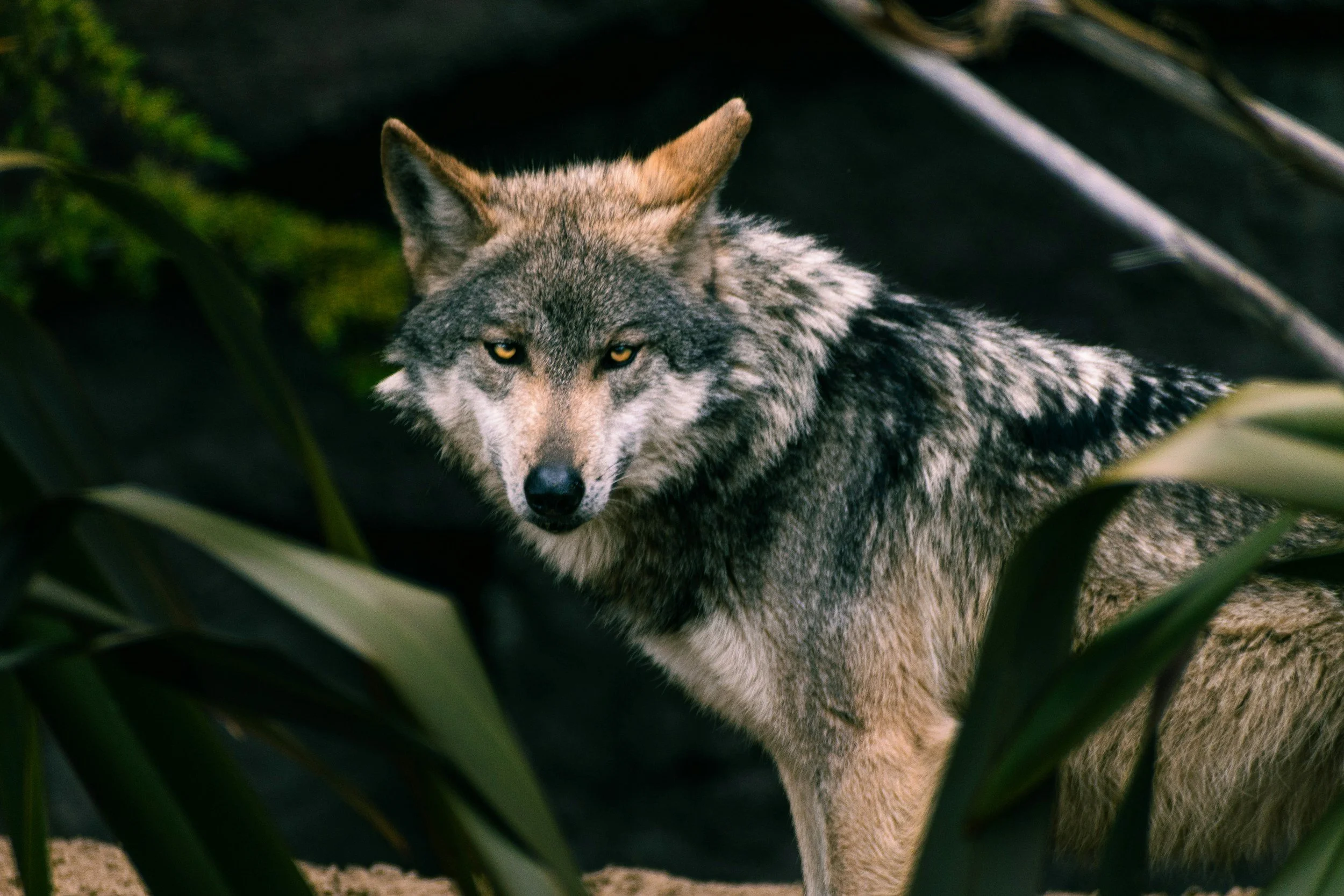
Ghost Trail
By Emily O’Neal
A scent on the wind
awakens strange memories.

In the misty dawn,
an old path reveals itself,
the invisible scent highway
is still warm and alive,
though it’s lived a hundred years
under a cloak of darkness and time.

The others don’t sense,
don’t feel, don’t smell
the ghost trail
of the ancestors
that beckon her
onward.

Every dusk and dawn,
a lonely howl towards the sky
before she takes another step
on an already thousand-mile journey.

A ghost wolf,
in a ghost forest,
on a ghost trail
following something —
a felt sense more than
a visible destination.

A hunger that doesn’t live in the belly,
an instinct that can’t be explained,
she is the continuation of a dream,
of a memory — she is the echo in time,
that is weaving the story of those who’ve been,
and those who are yet to be.

Utterly and completely alone — but not alone.
For she’s in communication
with distant ancestors,
long gone, but ever so close.

In solitude she roams
with each step braiding herself
into the story
of her wolf
ancestors.

The lone wolf perceives
what others cannot.

And though her path is very real,
it is also surreal,
piercing the veil of time
she walks a liminal line
straight through and straight to
ghost territory.

Does her mate
live on the other side
of the thin line
of todays and tomorrows?

Will she roam to
simply die?

What does it feel like,
to remember something
that you can’t see or touch,
but you can feel?

What does it feel like,
to follow ghost trails?

What does it feel like,
to be a lone wolf?

What does it feel like,
to remember,
what everyone else,
has forgotten,
and to search for it,
knowing, you might
never find it,
and that you too
will be forgotten — until
the next lone wolf
picks up the scent
of eternity.

Is it only in death,
that union,
will occur?

What secrets live,
in the heart of a
ghost wolf?