
I’ve been following Brit Hartley’s work for a while now. If you haven’t come across her, she runs No Nonsense Spirituality and does exactly what her name promises. She takes dense spiritual ideas and breaks them down in a clear, manageable way. Her commitment to education, discernment, and personal experience over rigid doctrine appeals to me. We come from different backgrounds, and our paths don’t look the same from the outside, but I recognize the same orientation: ask the hard questions, value direct experience, share what you’re learning, and keep growing. So, when she offered a course on mysticism with her own spiritual teacher, a Sufi mystic named David, I signed up.
Having spent years at the intersection of spirituality and direct experience, much of the ground that was covered was familiar to me. Even so, it was comforting to revisit teachings I’d set aside or forgotten about. But when David shared the Sufi teaching about the “dream caravan,” I was immediately drawn in. This teaching was completely new to me. Rather than dive into its origins or meaning, I want to start with the feeling the caravan brought up for me, because I suspect you’re familiar with it.
It goes something like this, you’re living your life, doing what you’re supposed to do, moving in the direction everyone else is going. Then, something begins to pull at you. Not dramatically, just a quiet, persistent sense that the path you’re on isn’t quite yours. Maybe it’s the religion you grew up in, a relationship, a career, or a rigid set of beliefs about what healing looks like. The people around you seem fine. The caravan keeps moving. And you start to wonder: Am I the problem, or have I just seen something they haven’t yet?
In other words, you start asking yourself hard questions, and the answers don’t come easily. That feeling has a name in the Sufi tradition, Talab, or the Valley of Yearning. It is the moment the soul wakes up and realizes it can no longer walk blindly with the crowd. While I was thinking about the dream caravan I couldn’t help but make a connection to the tarot. I’ll be sharing with you how that connection came to me and how it’s deepened my understanding of an important aspect of our spiritual landscape. More on that later.
Sufism is the mystical tradition within Islam, the branch most concerned with a direct, inner experience of the divine rather than external observance. Sufi practitioners pursue closeness with the sacred through poetry, movement, chanting, story, and contemplation. They are perhaps best known in the West through Rumi, but the tradition is vast. Sufi teachings have been shared for over a thousand years, often through stories passed directly from teacher to student.
The caravan teaching comes from that world. Its oldest written trace is a couplet attributed to Bahaudin Naqshband, a fourteenth-century mystic from what is now Uzbekistan and the founder of one of the most widespread Sufi orders in history. He wrote:
“Here we are, all of us: in a dream-caravan.
A caravan, but a dream; a dream, but a caravan.
And we know which are the dreams. Therein lies the hope.”
The image would have landed immediately for its original audience. Across the ancient Middle East, the caravan was the organizing structure of life, trade, pilgrimage, and survival. Everyone knew what it meant to be part of one, and everyone knew the brutal reality of the desert outside it. The metaphor didn’t need explaining.
The couplet points at something most of us recognize once it’s named. We are born into a caravan we didn’t choose — a set of inherited assumptions about what’s real, what matters, and what life is for. The caravan moves, it has momentum, and because everyone around us is on it, it can feel like reality itself rather than just one specific path through the world. We don’t question it. We just travel.
In Sufism, the caravan also represents something more intentional than collective habit. The traditional spiritual path, called the tariqa, moves through stages of inner purification, one slow, unglamorous step at a time, guided by a teacher. The caravan in this sense is structured and purposeful. It exists precisely because the desert is dangerous and no one should cross it alone.
While teaching about the caravan, David mentioned that at some point, most of us will question our place in it. Why are we going where we’re going? Who decided this was the direction? For some people, that questioning is a quiet, persistent wondering that lives alongside ordinary life. For others, it becomes a pull toward something else entirely: a side quest, a detour, a different path glimpsed from the corner of the eye. Sometimes that detour is exactly what’s needed. Sometimes it’s a mirage dressed up as a calling.
David wasn’t romanticizing either possibility. He was naming a conundrum many will face. Sufi teachers have thought carefully about this, and what they offer isn’t as simple as warning or a blessing. It’s something more complex.
One of the most common reasons a seeker drifts from the path is mistaking a temporary spiritual experience for a permanent arrival. You have a profound vision, a moment of deep ecstasy, or a dream that cracks something open in you, and it feels like you’ve reached the destination. So, you stop. You leave the caravan to dwell in that experience.
But Sufi guides teach that these moments, called hal, are passing gifts rather than permanent stations. The feeling isn’t false. The mistake is believing you’ve arrived when you’ve only been given a glimpse of what’s possible if you keep going. Clinging to a single spiritual experience, however real, can stall the very growth it was pointing toward.
The other danger they name is lonelier. When a seeker leaves the caravan to pursue the divine entirely on their own terms, without a guide, without fellow travelers, the desert has a way of producing mirages. What looks like water is sand. What feels like revelation can be the nafs, the ego, in very convincing spiritual clothing.
Sufi psychology is unflinching about how deceptive the ego can be, especially in isolation, and especially when there’s no one around to offer a reality check. This isn’t a warning against independent thinking. It’s a warning against mistaking your own reflection for God (or thinking you know all there is to know). It’s a reminder that we need other ideas and viewpoints to refine and challenge our own.
The tradition is clear that leaving the caravan, for whatever reason, whether by choice, exhaustion, distraction, or simply falling behind, is not the end of the story. There’s a verse often attributed to Rumi, though the authorship is genuinely uncertain, that most people have encountered somewhere without realizing it belongs to this exact teaching:
“Come, come, whoever you are. Wanderer, worshipper, lover of leaving.
It doesn’t matter. Ours is not a caravan of despair.
Come, even if you have broken your vow a thousand times.
Come, yet again, come, come.”
The true caravan of seekers never actually closes its doors. Falling away is expected; human weakness is a given. The question the tradition asks isn’t whether you left. It’s whether you have the humility to find your way back.
When David described this, I felt something shift in my mind. An image surfaced immediately: the Seven of Swords.
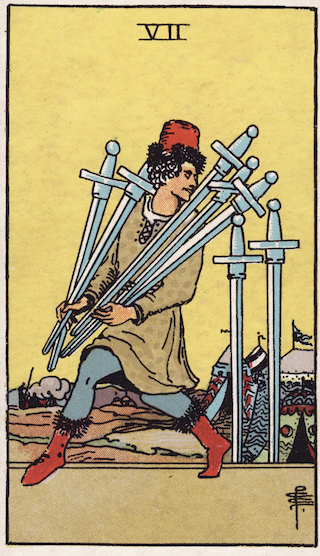
It wasn’t that I thought the tarot card was secretly an ancient Sufi teaching. It was more that the caravan metaphor suddenly illuminated something I’d always sensed in that card but didn’t have the words for. It opened a question I couldn’t let go of: What if someone leaves the dream-caravan? What does that look like? Why would someone do that, and what does it cost them?
If you know the Rider-Waite-Smith tarot, you know the image: a figure slips through an encampment carrying five swords, leaving two behind, glancing back over his shoulder. The traditional interpretation leans toward deception, cunning, and theft. However, that reading feels far too small for what the image holds.
Look at the setting. This is a desert. The camp behind him represents warmth, community, collective survival, and a structured path. By walking away, he is not slipping into safety; he is entering a harsh wilderness that he may not survive alone.
In this light, those swords are not stolen goods. They are the sharp tools of spiritual discernment needed to cut through illusion. They are the heavy truths he trusts for his survival. The two weapons left behind are not abandoned carelessly; they are left because he can only carry the truth he can live by. Even in the act of leaving, he knows his own limits.
Finally, that backward glance isn’t necessarily born of guilt. Perhaps it is the look of a waking soul looking back at those who are still asleep. It is the expression of someone who understands exactly what they are walking away from, weighs the stakes, and chooses to leave anyway.
Seen through the caravan teaching, this figure could be any one of us at a turning point:
The seeker who has genuinely been called forward, trusting an awakening they can’t yet name.
The wanderer who had a profound experience and mistook the brief glimpse for the final destination.
The isolated ego acting out of fierce, defensive self-reliance, whom the desert is about to teach a very hard lesson.
The soul who left, got lost, and is looking back with the first stirrings of readiness to return.
The card holds all of it. It doesn’t tell you which story you’re currently in. That backward glance is the very question David left in the room. It is not an accusation, nor is it a warning. It is just an honest invitation to look clearly at yourself.
What called you away from the path you were on? Was it a genuine summons or a beautiful mirage? Are you still out there relying entirely on your own weapons, or is it time to drop your defenses and find the caravan again? Where does the caravan exist in your life? Is it something to find within, or something to find in external realms? Is it both?
The card doesn’t answer that. The teaching doesn’t either. They just name the threshold, hand it back to you, and wait. Which is, I think, what the best teachings always do.
I’ll leave you with some questions a Sufi mystic might ask.
What caravan were you born into, and who told you this was the road?
What is your yearning pointing toward, and have you been mistaking the finger for the moon?
Are you leaving because you have seen something true, or because the journey has become uncomfortable?
What are you carrying that was never yours to carry?
What would it cost your pride to ask for guidance?
Have you ever heard of the dream caravan? What do you think about this spiritual concept? When you look at the Seven of Swords, what do you see? Perhaps your reaction to this archetype says something about your relationship to the caravan at this time.
Do share, you know I love to hear from you.