
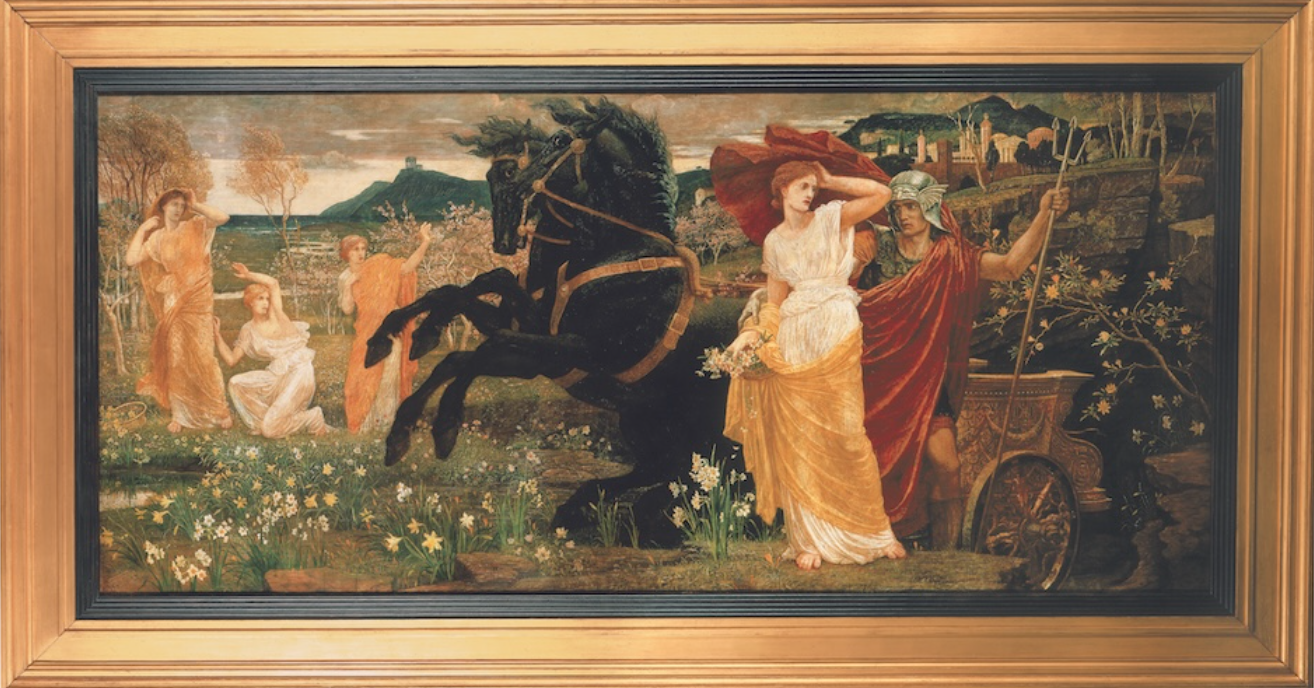
Walter Crane’s The Fate of Persephone (1877), depicting the moment Hades’ dark steeds emerge from the meadow as Persephone gathers narcissus blossoms.
Welcome to Blooming with Emily, a place to dive into spiritual and self-care topics from the perspective of a working evidential psychic medium. Here, I write about the themes and experiences that come across my “desk” at work.
We’re now three steps into our seven-part journey with Persephone and Demeter.
In the first piece, we explored the myth and the Eleusinian Mysteries.
In the second, we sat with Demeter’s grief after her daughter was stolen from her.
In this third installment, we turn to Persephone herself and follow her down into the underworld. If you haven’t read or listened to the other installments, you don’t have to, but they add helpful context to this one.
Now, let’s descend.
The narcissus, which Earth made to grow at the will of Zeus and to please the Host of Many, to be a snare for the bloom-like girl — a marvellous, radiant flower... And the girl was amazed and reached out with both hands to take the lovely toy; but the wide-pathed earth yawned there in the plain of Nysa, and the lord, Host of Many, with his immortal horses sprang out upon her — the Son of Cronos, He who has many names. He caught her up reluctant on his golden car and bare her away lamenting... And so long as she, the goddess, yet beheld earth and starry heaven and the strong-flowing sea where fishes shoal, and the rays of the sun, and still hoped to see her dear mother and the tribes of the eternal gods, so long hope calmed her great heart for all her trouble...”
— Homeric Hymn to Demeter, lines 8–37, trans. Hugh G. Evelyn-White (1914)
Persephone is gathering roses, crocuses, violets, irises, and hyacinths in a meadow with the daughters of Oceanus. Then she sees the narcissus. It was grown by Gaia, the Earth herself, as part of Zeus’s plan, a lure meant just for her. It was a marvel, a hundred blooms rising from a single root, its fragrance so sweet that heaven, earth, and sea seem to laugh with joy. Persephone is filled with wonder and reaches for it with both hands.
The moment she does, the earth splits open. Hades rises from below in his golden chariot, drawn by immortal horses, and seizes her. She is carried away against her will, crying out to her father, Zeus. But Zeus is far away receiving offerings. Only Hecate in her cave and Helios the sun take notice.
As the chariot plunges downward, her cry echoes off the mountain peaks and the depths of the sea. She enters the darkness of the underworld, and all light is gone.
Here the hymn tells us nothing of what Persephone saw or felt as she entered the realm of the dead. The next time we glimpse her, she is seated beside Hades in his palace: reluctant, withdrawn, longing for her mother. She is no longer the girl in the meadow, but she is not yet the queen she will become. She is simply there, in the dark, waiting. She has no words for what has happened to her.
This is where I’ll pause the telling of the story so that we can explore what we meet when we are taken under.
Persephone didn’t choose to go down to the underworld. Most descents aren’t chosen: a faith falls apart, a body changes, a relationship ends, a loved one dies. This episode is about what we meet down there, and the fact that the body usually gets there before the mind does. We, like Persephone, often experience a change, be it spiritual, emotional, physical, or mental in nature, and then feel at a loss as to how to orient ourselves in it. It takes time for context to arise, and waiting for that context and understanding can feel really uncomfortable, even hopeless.
Persephone was reaching for something beautiful. The narcissus was a marvel, a hundred blooms from a single root, so fragrant that heaven and earth seemed to laugh. She reached for it with both hands, and the ground gave way beneath her. What looked like a gift was a snare.
I think many of us know this feeling. We’re reaching for something good: a relationship, a career, a sense of peace we’ve worked hard for. Then, out of nowhere, the ground drops out from underneath us. And the first thing most of us say when this happens is some version of this isn’t supposed to be happening. I didn’t sign up for this. This isn’t what I expected. We feel tricked. We feel caught off guard. We feel betrayed by life. And that feeling of betrayal can leave us feeling lost and disoriented.
I want to take a second to make some connections to this idea of the snare. A snare is a tool used to capture small animals. They hide in the landscape, waiting for a rabbit or a bird to step into it. When they do it snaps shut, and the animal is caught, unable to escape. A snare is hidden until you step into it.
Think of Persephone walking freely through childhood, unaware of societal expectations, responsibility, and the impending threshold of womanhood. When she reaches for the narcissus, she crosses that threshold, moving unknowingly from girlhood to womanhood. It is the beginning of the end of her innocence. She didn’t plan or anticipate this life altering experience.
Ancient Greeks called her Kore (meaning maiden, girl, or daughter) when she was the carefree goddess of spring and new growth. But she is also Persephone, Queen of the Underworld. The meaning of the name Persephone is uncertain and debated, but ancient writers linked it to bringer of death, and many today interpret it as “she who destroys the light.” I find it helpful to see these two names as two sides of her nature. As Kore, she represents youth, springtime, innocence, and her identity as Demeter’s daughter. As Persephone, she represents maturity, power, the autumn and winter seasons, and her sovereign authority as ruler of the dead.
When we consider the snare, both the narcissus and the actual tool, we see that we get caught by simply doing what we’re supposed to do. It triggers in an instant, like a first heartbreak, moving from one stage of life to another, losing something or someone precious to you. It snaps shut and permanently alters the landscape of your life. I don’t know that snares are good or bad, but I do know that they are inevitable. We’ve all fallen into one.
Carl Jung had a name for the realm Persephone fell into, or at least for its inner equivalent. He called it the shadow. For Jung, the shadow holds all the parts of ourselves we’ve pushed out of sight: the anger we weren’t allowed to show, the grief we never tended, the desires and needs that didn’t fit who we were supposed to be. We don’t disown these parts because we’re weak. We disown them to stay safe, to be loved, to belong. But these parts of our consciousness don’t disappear. They go underground, and they wait.
Jung also believed that meeting the shadow is not optional if we want to become whole and fulfilled as individuals. He called the lifelong process of becoming our truest selves individuation, and he saw descent as part of that path. In his own life, after a painful break with his mentor Freud, Jung went through years of inner upheaval that he recorded in what became The Red Book. He didn’t escape his underworld. He went down into it, paid close attention, and came back with the foundations of his life’s work. To Jung, the goal was never to defeat the shadow or banish it. The goal was to make it conscious and to integrate it, to let what was hidden become part of us.
That’s exactly what Persephone does. She doesn’t simply escape the underworld. She eats from it. She carries a piece of it back inside her, and that’s what makes her a queen of two worlds rather than a girl who had a terrible thing happen to her.
But before any of that, there’s a long stretch of darkness. In the hymn, the next time we see Persephone, she is seated beside Hades, reluctant and withdrawn, yearning for her mother. She isn’t transforming yet. She’s just stuck. And this, I think, is the part of the journey we talk about least: how easy it is to fall into despair once we’re down there.
I recently listened to an episode of the Hidden Brain podcast called “Why Am I Unhappy?” featuring the psychologist and behavioral economist George Loewenstein, and it shed a lot of light on this stuck place for me. Loewenstein explains that evolution built our brains to keep us alive, not to keep us happy. Our good feelings tend to fade quickly, while our painful ones linger, take over our attention, and shape how we act. In other words, the underworld has a stronger pull than the meadow. That’s not a personal failing. It’s human design.
Even more striking, he describes how negative emotions create feedback loops: when we’re down, our brains automatically pull up other painful memories, which deepen the sadness and make relief seem out of reach. One dark thought calls up another, and another, until the whole world looks like the underworld.
Then there’s what he calls meta-emotion, our feelings about our feelings. We feel sad, and then we feel ashamed of being sad. We feel lost, and then we judge ourselves for not having found our way out yet. In his book, The Opposite of Happiness, Loewenstein argues that our efforts to escape misery often make it hurt more.
This is where the shadow and the science meet. That voice that says this isn’t supposed to be happening is the second wound. The first wound is the rupture itself, the loss, the change, the ending. The second is our refusal to accept that we’re in it. And that refusal is often what keeps us circling in the dark.
So how do we orient ourselves once the shadow has swallowed us? We start by naming where we are. I’m in the underworld. That simple act moves us from drowning in the experience to witnessing it.
Then we gently set down the second wound, the story that says we shouldn’t be here, even if only for a moment. We notice the loop when it starts, when one painful memory begins calling up the next, and we remember that this is the mind’s old survival pattern, not the whole truth of our lives. We look for Hecates and Helios, our witnesses, the ones who hear our cry — because silence lets our problems stay hidden and our self-judgment grow. And like Persephone, who held onto hope for as long as she could see the sun, we find one small light we can still see and keep our eyes on it.
And then at last, we come back to the body. When the mind is spinning, the body is the ground we can stand on. It knows things before the mind does, which is where we’ll turn next.
A gentle but important note before we go further: shadow work can stir up a great deal, and descending into the dark is not something you have to do alone. If you find that the darkness isn’t lifting, that the loop feels unbreakable, or that you’re struggling to function in your daily life, please slow down and reach out to a therapist or another trusted professional. Bringing in support isn’t a failure of the journey. It’s how we make sure we come back.
The Descent Journal Prompts
The Descent Journal Prompts
1. The Meadow: before the ground opened
Persephone was simply gathering flowers, doing what she always did. Think of a time in your life when you experienced a descent, then ask yourself the below questions.
What was my life like just before my descent? What was I gathering, tending, or taking for granted?
What would I want to say to the person I was in that meadow?
2. The Narcissus and the Snare: the beautiful lure
A snare stays hidden until we step into it, and often we step in by doing exactly what we were supposed to do. Think of a time when the ground gave way beneath you, then ask yourself these questions.
What beautiful thing was I reaching for when the ground gave way?
Looking back, can I see the snare now? Or is it still hidden from me?
3. From Kore to Persephone: crossing the threshold
The maiden who reaches for the flower never returns in the same form. Think of a time your relationship to childlike innocence was forced to change, then ask yourself these questions.
What season of innocence did I leave behind, and what did I come to know?
Which parts of me are still like Kore, and which parts of me have become Persephone?
What’s my relationship to each? What’s their relationship to each other?
4. The Cry: who heard me
Persephone called out, and almost no one heard. But Hecate and Helios did.
When I cried out, in words or in silence, who heard me?
Who are my Hecates and Helioses now, and have I let them know where I am today?
5. The Last Light: holding on to hope
As long as Persephone could still see the earth, the sky, and the sun, hope calmed her great heart.
What is the one small light I can still see from where I am?
What happens in me when I turn toward it, even briefly?
6. Beside Hades: before the words come
The hymn falls silent here. Persephone has no words yet for what has happened to her.
What in my life still has no words? Can I let it be wordless for now?
If I named where I am, simply “I’m in the underworld,” what would shift?
In our next installment, we’ll go deeper still, into the realm of the dead itself, where Persephone learns she has power in the dark. We’ll explore what it means to become queen of our own underworld and how to engage the dead with clear boundaries.
In the meantime, take your time with the journal prompts I’ve offered here. Shadow work can stir up a lot, so go gently, and reach out for support if you need it.
If you’d rather listen or watch, you can follow along on the Blooming Wand podcast, available wherever you listen to podcasts, or on YouTube. I tend to share a bit more in those versions, since I approach the topic more conversationally, and that extra context might help you engage with the prompts more easily.
Until then, may you find one small light you can still see, and keep your eyes on it.