
Let us continue our journey with Persephone and Demeter in this second installment of a seven part series that explores their powerful myth and how it can support us in our own spiritual and self-care practices. In this article we’re going to explore grief by looking at what happened to Demeter when her daughter was stolen from her.
Let’s dive in.
Part 2: Demeter’s Grief
That I plucked in my joy; but the earth parted beneath, and there the strong lord, the Host of Many, sprang forth and in his golden chariot he bore me away, all unwilling, beneath the earth: then I cried with a shrill cry. All this is true, sore though it grieves me to tell the tale.
— Homeric Hymn to Demeter, lines 429–433, trans. Hugh G. Evelyn-White (1914)
Most of us don’t dive into self-care and spirituality because we’re curious. We start because something ruptured. I can remember times in my life, usually when I’m at a crossroads, that I’ve felt tremendous grief. When I graduated High School, I felt so sad and adrift, I didn’t know who I was or what I wanted. To find my path, I tore myself away from my family, and at the tender age of eighteen bought a car with the paper route money I’d saved and moved out of the family home. I would describe this period as a descent into my underworld. I wouldn’t want to relive this time in my life.
That said, I did learn that I could take care of myself. That I could do most things I set my mind to, and that I didn’t need the old ways of my parents and my parents’ parents anymore. I was forming new beliefs and worldviews that better aligned with my true self and what was essential to me. And slowly, with time, I came back to the light and found my way to college where I would immerse myself in studying history, art, archeology, and anthropology. Little did I know, those twenty years ago, that those studies would become foundational to the work that I do today.
Today, I am forty-five, standing at the center of life, or the middle of the cyclone as one of my favorite musicians Neko Case would say. I’m not young, but I’m not all that old either, depending on how you look at things. I feel a sense of loss and grief I can’t explain or describe, and this, at least to me, is an indication of an upcoming journey to the underworld. I feel in my bones I’m descending a staircase, slowly and with more confidence than the times before, and as the space around me grows darker, I’m becoming more and more curious – and a bit afraid – of what I might find in the deep cavern of my being.
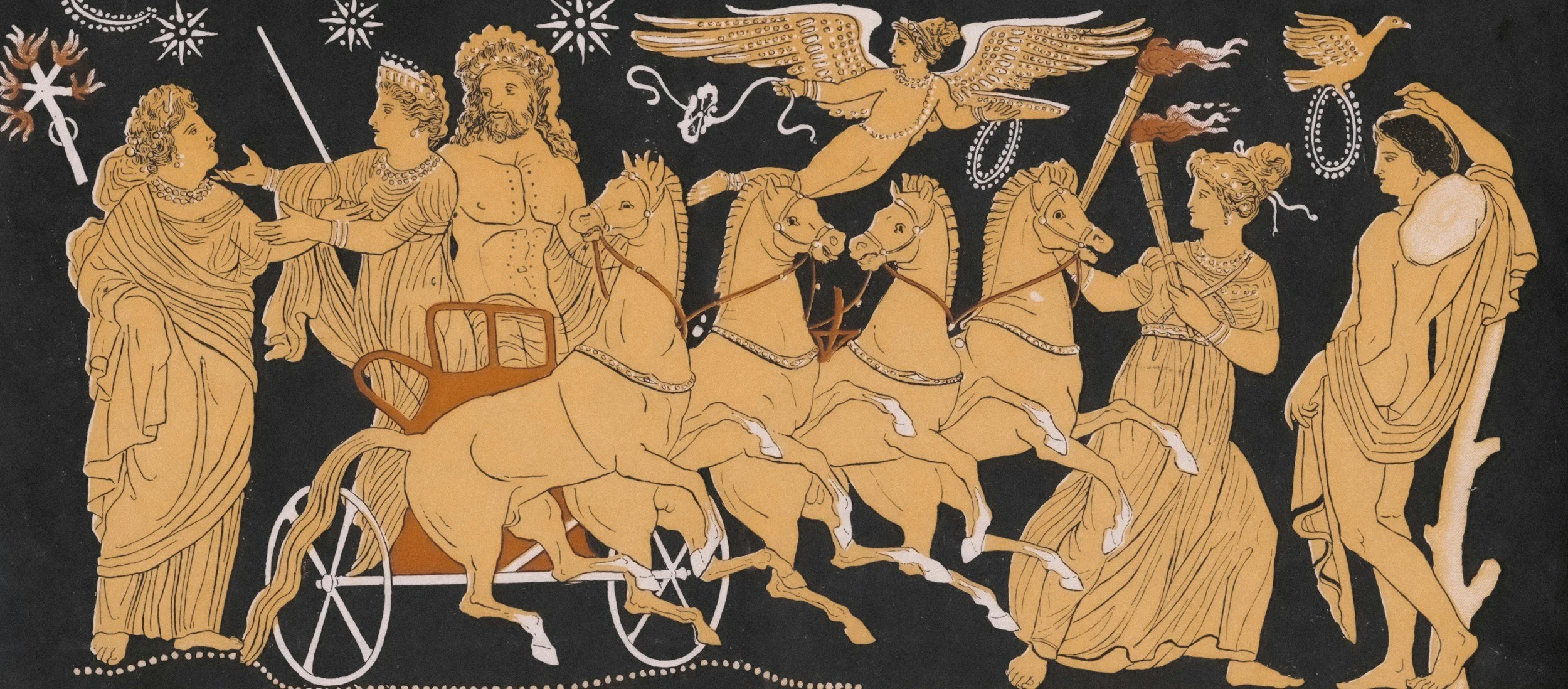
In this segment I want to explore Persephone’s kidnapping to the underworld (the rupture) and the grief and longing that resulted for her mother Demeter. The beginning of this tale goes a little something like this. Persephone is picking flowers when the earth cracks open violently, and Hades, on his golden chariot drawn by dark horses carries her away to the underworld. No trace of the torn earth or capture is left behind. Only Hecate and Helios hear Persephone’s cry. I find it interesting that anyone heard her cry at all. Perhaps there is some comfort, or a foreshadowing in that witnessing, what do you think?
Bitter pain seized her heart, and she rent the covering upon her divine hair with her dear hands: her dark cloak she cast down from both her shoulders and sped, like a wild-bird, over the firm land and yielding sea, seeking her child.
— Homeric Hymn to Demeter, lines 40–44, trans. Hugh G. Evelyn-White (1914)
Demeter wanders for nine days with torches, not eating or bathing, in search of her daughter. Her pine torches cast frantic shadows across the landscape. She refuses the nectar of the gods, rejects nourishment and water. In doing so she becomes filthy and tattered and old. She becomes an old woman, embodying the barrenness that creeps across the earth. By the tenth day, all her divinity has dropped away. She has become the crone.
When she comes to Eleusis she sits down by the Maiden Well under the shade of an olive tree. She is a stranger to the joys of life. Soon the daughters of the local king find her and bring her to their palace, sharing all their hospitality with her. But Demeter refuses their kindness and sits in silence. Eventually, a servant named Iambe steps forward. She shouts crude jokes and spews absurdity. Demeter’s facade slips, and she smiles and laughs. The ridiculousness of humanity reminds her that even when sadness engulfs, life still pulses.
The family of the local king hire Demeter to nurse the king’s infant prince, and she pours all her love and longing into caring for the child. She does not give the child milk, instead feeding him ambrosia while breathing her divinity into his lungs. It’s not long before she tries to forge the child into a god by burying him in the hot embers of the hearth fire.
His mother, the queen, sees this and screams in horror. Demeter, furious that the queen can’t see the gift she offers, pulls the child from the ashes and reveals her divine form. The boy remains mortal and Demeter commands the people of Eleusis to build her a grand temple with an altar at its center. They do so, and upon its completion she retreats into its walls, cutting herself off from Olympus, her duties, and humanity.
She sits alone in the dark, letting the whole world starve while she grieves.
This is where I’ll pause in the telling of this story so that we might explore some important themes that have arisen so far. Take a moment to get your journals out or grab your phone to take some voice notes. Read or listen to what you come up with when you are done, and see what jumps out to you after engaging in this exploration.
Demeter’s Grief Journal Prompts
1. The Unexpected Descent: the earth cracks open at the crossroads
We’re sometimes taken into the underworld rather than choosing to go, often at turning points, when one life ends before the next has begun.
When has the ground opened beneath me without warning? What was I reaching for just before it happened?
What crossroads have brought me grief, and what did I have to leave behind?
What did that descent ask of me that I couldn’t have learned any other way?
2. The Witnesses: Hecate and Helios hear the cry
Even in our most isolated moments, some part of us, or something beyond us, is listening.
Who or what heard me when I felt no one could?
Is there a quiet inner voice that knew what was happening before I did?
What would it feel like to believe I was witnessed in my hardest moment?
3. The Torch: the frantic search
Grief searches everywhere at once. Learning to hold the light still is the beginning of intuition.
What am I still searching for?
Where am I casting light in every direction and seeing nothing?
What might I notice if I stopped searching and simply held the light still?
4. Refusing Nourishment: closing the door on care
Grief can close us off from food, rest, pleasure, and kindness. That refusal is often protection, or protest.
What have I stopped letting in? What kindness have I turned away because I wasn’t ready?
Is my refusal protecting something? What am I saying “no” to?
What is one small, plain thing that could nourish me today?
5. The Crone: divinity dropping away
Loss strips away the roles and radiance we thought defined us and sometimes leaves us feeling unseen. What remains is essential.
What identity or role fell away from me in a season of grief?
Who was I underneath it, and who truly sees that person?
What wisdom did I find only after something was stripped away?
6. The Well and the Laughter: life still pulses
Even in the middle of the journey, there are places to rest and moments of absurd, surprising joy.
Where is my “well,” the place I go to sit when I’ve wandered too long?
When has laughter surprised me in a dark season? Who are the Iambes in my life?
Can I let lightness exist alongside my grief instead of feeling it betrays my loss?
7. The Child in the Fire: rushing the transformation
Grief looks for somewhere to pour its love and sometimes tries to forge something permanent, so we never lose again. Real change can’t be forced.
Where have I poured my longing after a loss? Was it healing, or a way of not feeling?
What have I tried to make “immortal,” and where am I rushing a change that needs time?
Is part of me crying “not like this”? What is it trying to protect?
8. The Temple: sanctuary or tomb
Grief needs a dedicated place, but withdrawal has a cost, and the world around us feels our absence.
Where is my temple, and is it a cocoon or a tomb right now?
What sits on the altar at the center of my grief?
What has gone barren around me while I’ve been in the dark, and what would one step back toward the world look like?
In our next installment of this series we’re going to take things a step further by exploring Persephone’s descent into the underworld. I personally find exploring the underworld very exciting! How about you? Are you afraid of the dark?
In the meantime, take your time with the journal prompts I’ve offered here. And if you prefer to listen or watch, know that you can do so by listening along via the Blooming Wand podcast, available wherever you like to listen to podcasts. You can also watch on YouTube.
I tend to share a bit more when I record the podcast and YouTube videos because I’m approaching the topic in a conversational way, and that might help you engage the journal prompts with greater ease and clarity.