
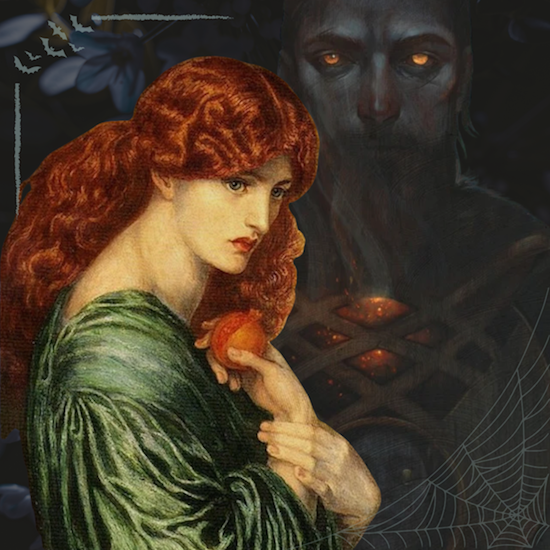
Welcome to Blooming Wand, your home for grounded spiritual content. I’m Emily O’Neal evidential psychic medium, intuitive healer, and spiritual mentor. First off, I want to say welcome, I’m so glad you’re here.
I’m always looking for interesting ways to explore spirituality and self-care. That might sound like I’m searching for topics, but that’s not really the case. I often find inspiration strikes out of nowhere, usually on a typical day, doing typical things. That’s certainly the case for this new series I’ve crafted for you.
You may or may not know this about me, but I’ve always been fascinated with myths, legends, and folklore. As a kid my dad had an office space in our home that had an entire wall, from floor to ceiling, filled with books. I loved to grab Greek and Roman mythology off those shelves. I’d like to say that it was because the stories were exciting and fun to read, but it was really for the gore, the violence, and the shocking turn of events that frequent these tales.
One such tale I’ve always felt really drawn to is that of Persephone and Demeter. I find myself thinking about these mythical women when autumn arrives. After all, their story, at least in part, explains why we have seasons. It also tells us something that I believe is just as important, which is a story of rupture, grief, darkness, and the return to light. Sadly, in many Greek mythology compilations, their story doesn’t get as much attention as I would like. In many translations the text often no more than a few paragraphs. So, to further my understanding of this story I turned to the “Homeric Hymn to Demeter.” In reading this short text I felt like I got more insight into the powerful myth of Persephone and Demeter and why it’s captured my interest for so long.
Over the next few weeks, I want to explore this myth with you and share why I think it can be a useful tool in our self-care and spiritual practices. I’ve timed this seven-part series, which I’m calling “Queen of Two Worlds: Persephone’s Journey to the Realm of the Dead and Back Again” to honor natural cycles. We will begin around Samhain or Halloween and end around Imbolc, when the first signs of spring emerge. Each episode will arrive on a full or new moon. I’m intentionally crafting and releasing this content in a ritualistic format, marking significant shifts in the seasons and moon cycle.
I going to lean into the symbolism the myth offers, and I’ve even written a poem for you to recite as we begin the sacred journey together. I want you think of each phase of our seven-part journey as a way for you to engage your spiritual self through mythology. Think of yourself as a mythical figure. Let your imagination and intuition guide you as you listen. So, take a deep breath, grab your journals, let’s dive in.
Happy is he among men upon earth who has seen these mysteries; but he who is uninitiate and who has no part in them, never has lot of like good things once he is dead, down in the darkness and gloom
— Homeric Hymn to Demeter, lines 480–482, trans. Hugh G. Evelyn-White (1914)
For more than a thousand years (from around 600 BCE until the Roman Empire banned the rites in 392 CE) people in ancient Greece traveled to a small town called Eleusis, just outside Athens, to take part in a sacred initiation built around the myth of Persephone and her mother Demeter. These are names we’ve come to know well, from pop culture to the middle school classroom, many have heard a little something about a mother who lost her daughter to the King of the Underworld, but this story likely pre-dates the names we’ve come to know so well. This is a very, very ancient tale that has guided humans for thousands of years, which is why I wanted to explore it in depth with you.
Long before the story of Persephone and Demeter, the people of Eleusis were farmers whose lives depended on grain. Every year they watched the cycle of life. The seeds of grain fell to earth, and with the spinning of the Great Wheel, returned as grain come summer. I would imagine that an agrarian community such as this would naturally honor the powers behind the harvest, perhaps in the form of a grain mother and her young grain daughter.
Over time, farming rituals were given a story. The grain mother became Demeter, the young grain became her daughter Persephone, and the yearly cycle became a family drama of abduction, grief, and return. The myth explained why the earth goes barren and why it comes back to life in spring.
The rites and rituals centered around, and in honor of, Persephone and Demeter became the Eleusinian Mysteries. What began thousands of years ago as a prayer for a good harvest has become (perhaps it always was) a promise, a prayer, a simple truth, that we too might pass through darkness and return whole and new. That like the earth, we also have seasons of birth, death, and renewal.
Today, most of us don’t plant fields, but we still live by the same cycles. We know seasons of loss and seasons of renewal, times when part of us goes underground and times when we come back changed. That’s why the story still speaks to us so clearly and why I want to explore it as part of a spiritual and self-care practice today. It reminds us that the dark isn’t the end, and that painful ruptures can be part of how new life begins.
I’ll quickly add that even though most of us don’t plant fields anymore, this myth might do some good work in reminding us that we are still very much bound to the growth cycles of the plants and animals that feed us, and while we are exploring this story from a spiritual perspective, let us also consider our spiritual connection to the food that sustains us.
Let’s begin with a brief overview of their tale and then dive into what this ancient myth can offer us today. In the sections that follow, I’ll be diving more deeply into various portions of this story, giving you even more details from the “Homeric Hymn to Demeter,” which is the primary text I’m referencing. This text is an ancient Greek poem whose author is unknown/anonymous. It narrates the abduction of Persephone by Hades and details Demeter’s grief-stricken search for her and subsequent famine. This text becomes the foundation of the Eleusinian Mysteries.
The Story of Persephone and Demeter
Persephone, daughter of Demeter, goddess of the grain, is gathering flowers in a meadow when she sees a narcissus more beautiful than any she has ever seen. When she reaches for it, the earth splits open, and Hades, lord of the underworld, carries her below. Two figures hear her cry. The first is the sun god Helios. The second is Hecate, goddess of some very interesting things (at least to me), which include magic, witchcraft, the night, the moon, ghosts, necromancy, and crossroads.
Demeter searches the earth for nine days with torches in her hands, not stopping to eat or bathe. On the tenth dawn, Hecate comes to her, also carrying a torch. She tells Demeter she heard the girl’s cries but couldn’t see who took her. Together the two goddesses go to Helios, who saw everything, and he tells them the truth: Zeus himself gave Persephone to his brother Hades to be his wife.
Grieving and furious at Zeus’s betrayal, Demeter leaves the gods behind and wanders among mortals disguised as an old woman, until she comes to Eleusis. There, the king’s family takes her in. A servant named Iambe makes her laugh for the first time since her loss, and Demeter becomes nurse to the infant prince, secretly trying to make him immortal in the hearth fire, until his mother discovers her. Revealing her divinity, Demeter orders the people to build her a temple, retreats inside it, and holds back every seed. Nothing grows, and the world begins to starve.
At last, Zeus sends Hermes to bring Persephone home. In the underworld, Hades lets her go, but first he tells her she will be queen of all that lives and moves in his realm. Before she leaves, he gives her a pomegranate seed, and because she eats it, she must return below for a third of every year.
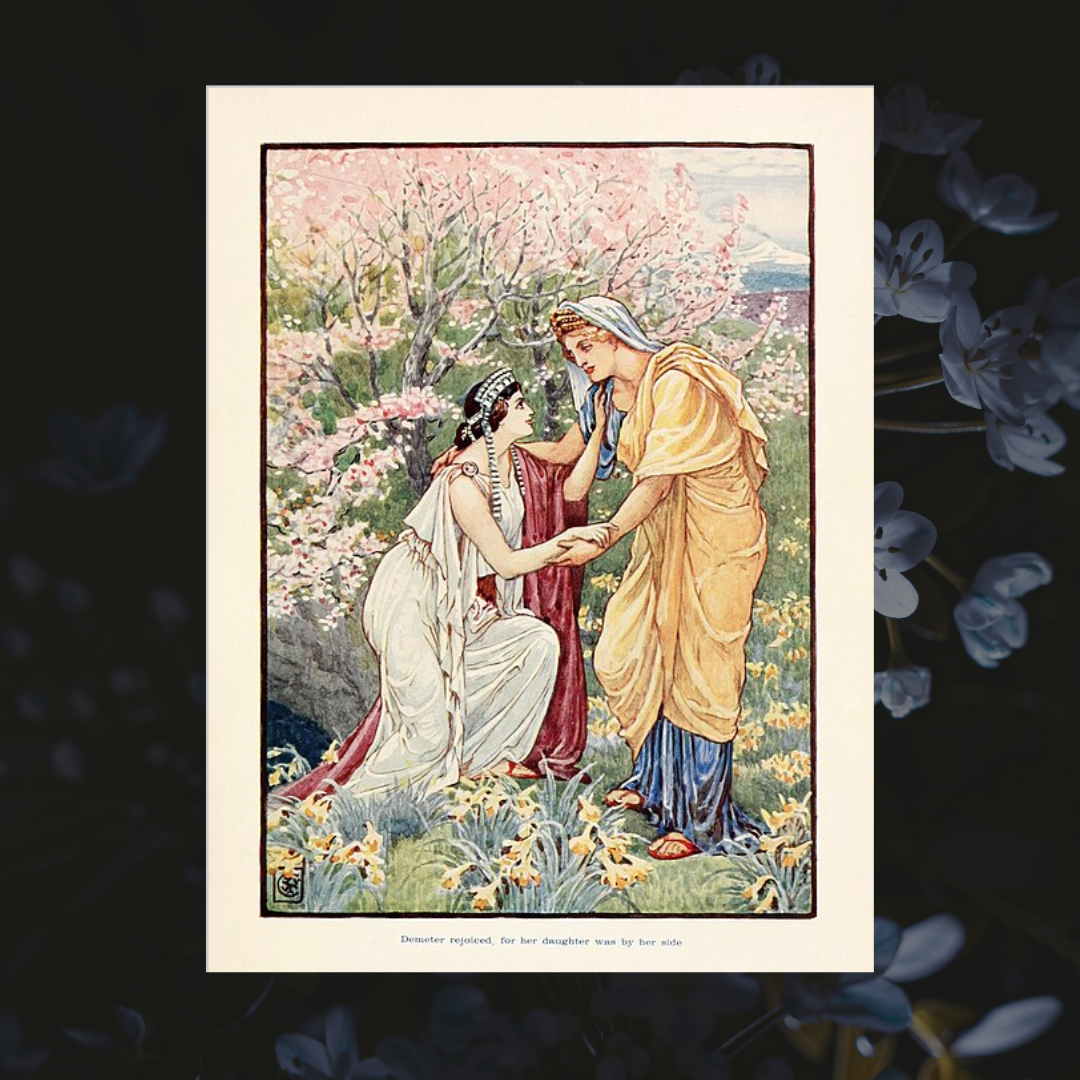
Mother and daughter are reunited, and Hecate comes to greet them. She embraces Persephone, and from that day on she walks beside her as her companion and guide, the one who knows the way between worlds. Demeter lets the fields bloom again. When Persephone goes below, the earth rests in winter. When she rises, spring returns.
Before she leaves Eleusis, Demeter gives the people one more gift: her sacred rites, which became the Eleusinian Mysteries.
Myth As A Trusted Guide
Those who practice these rites walk in Demeter’s footsteps through grief and darkness and find themselves transforming with Persephone’s return. It is said that those who study and practice the Mysteries no longer feared death the way they once did. I think this is because these Mysteries offer a universal truth about how transformation happens.
We don’t choose most of our descents. The ground opens under a marriage, a diagnosis, a faith we were raised in, the loss of someone we can’t imagine living without. This myth doesn’t pretend that isn’t devastating. But it also promises something we often forget, the underworld is not the end of the story. Persephone eats from that dark place, carries something of it back with her, and returns as a queen who belongs to both worlds. That is the shape of a spiritual life. We go down. We meet our shadows and our dead. We come back changed, and what we bring back because the seeds of spring.
There’s an old way of reading myths where nobody in the story is a stranger. Every character is a part of you. The one who gets taken, the one who searches, the one who holds the light: all of them live in the same person, and all of them show up when life pulls us under. That’s how we’ll walk through the story of Persephone and Demeter in this series. Not as a tale about gods who lived long ago, but as a map of something you’re already living. As you come to know and understand each character, consider how you embody their archetypal energies both today, and in the past. Has loss that stopped your world? Have you spent a season in darkness? Have you slowly, and over time, returned to the light and back home to your truest self?
As we meet each figure along the way, we’ll ask the same question: how do I relate to them?
Over several episodes we’ll follow these figures down into the underworld and back again. Along the way you’ll learn to feel, listen, taste, see, and know in new ways, to meet your shadows and your dead with clear boundaries, and, hopefully, come back carrying something worth planting. Persephone went down a girl and came back a queen of two worlds. You can come back changed too.
One last note before we begin. Each of the following segments or episodes represents a phase or aspect of a journey that typically takes months, if not years. Think about it, when was the last time you really had a hard time in your life? As you reflect, you might realize that it didn’t last just a few weeks or months, it probably lasted longer than that. Hard times can last a while, and we don’t often move through the phases in days or weeks.
Sometimes, when we’re really in the thick of things, we don’t know we’re in a rupture phase, or a descent phase, or an emerging phase. Often, it takes hindsight, or the help of friends and healers, to help us see where we’re at in our journey. As you follow along, know that we’ll be covering all the phases, by the time we’re done, you might find yourself drawn to one portion of the journey over another. That’s where you should dive in and pay special attention. Take your time with the journal prompts I’ve outlined there. See what they have to offer and let me know how it goes.
Now, let’s begin our journey with a poem I’ve written to initiate this sacred time we’ll be sharing as we explore an ancient myth, it’s secret mysteries, and the potent medicine it still offers today.
Let’s begin.
The Song of Persephone and Demeter
Queen of the Harvest, Daughter of the Deep,
walk with me as I travel to the underworld—
walk with me as I rise again in my own perfect time.

Let what is buried in me return as Spring.

Queen of Eleusis, giver of gifts, bringer of seasons,
may you and your daughter be gracious and bless this journey.

As I begin to sing my song to you,
let my heart remain open, let my gratitude flow freely.
May my feet hold true to a path that honors you and your song.

Hecate of the crossroads, keeper of the torch,
light my way down and guide me home again.
Let me see what you already see.
Let me know what you already know.

To all who walked the Sacred Way before me,
I follow in your footsteps.
Please make room for me in the procession.
As we unite, sharing in our grief and heartbreak,
let me find comfort in the knowing that I do not walk alone.

As the light wanes, and the seeds of my being go to earth,
I open the door and step through.
Goddesses of grain and shadow, receive me.

May I go with courage,
may I be held in the dark, and may I return
carrying the seeds of a bright future.
Join me next time and we’ll explore more of the “Homeric Hymn to Demeter” in detail, specifically the section where Demeter, driven by deep grief and despair, goes in search of her daughter. In this installment we get to talk about how this ancient tale can be a guide to one of our most powerful emotions — grief.