
Born on Imbolc: Brigid, the Sacred Flame, and the Return of Light
My birthday falls on Imbolc (IM-bulk), and I’ve felt connected to the magic of this turn in the Great Wheel for as long as I can remember.
It’s a time when early signs of spring emerge. A crocus here, a green shoot of a daffodil there. I’ve always felt this was a special time, not because of my birthday, but because of the juxtaposition of tiny spring buds against harsh rains and snows. Early spring blooms seem so tender, but they are remarkably resilient, often surviving freezing temperatures and snow.
My mother, who was raised Catholic, always pointed out the significant turning points in the seasons. She was the one who told me my birthday was connected to Imbolc and the goddess Brigid. Even within her Catholic framework, she understood that something sacred was happening at this time, something older and deeper than any single tradition could contain. I thought it might be nice for us to explore this special time together, and to see what wisdom we might find in honoring the goddess Brigid and Imbolc.
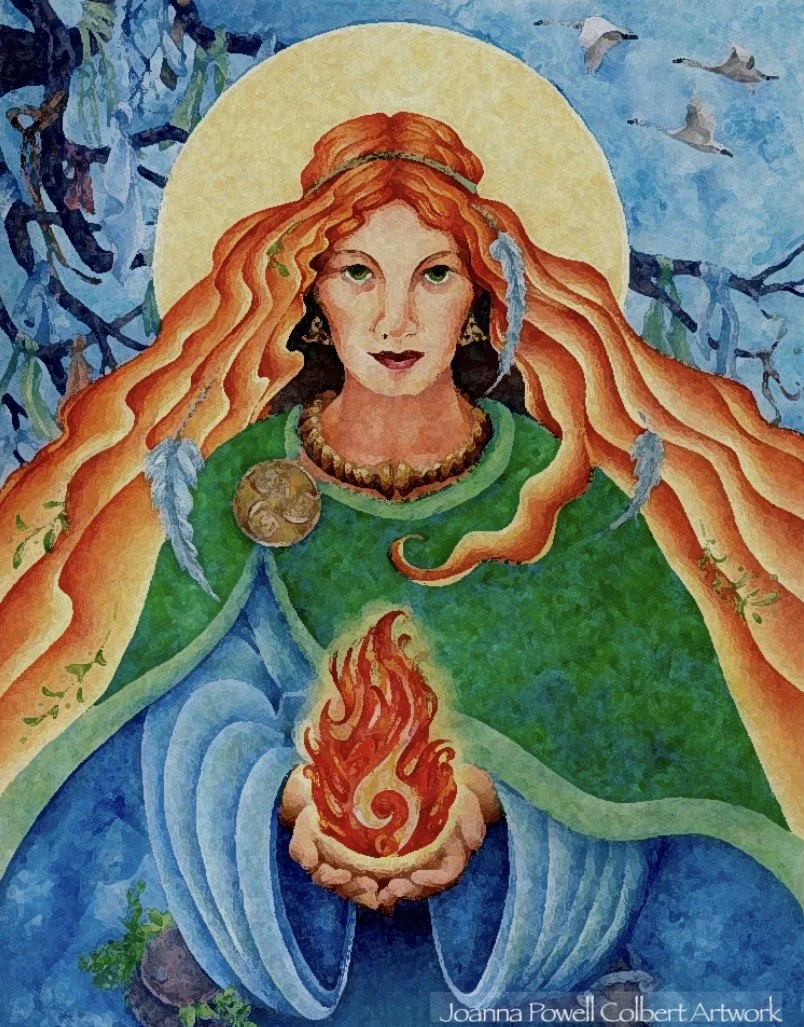
Check out Joanna’s amazing artwork here https://joannapowellcolbert.com
Why Imbolc mattered to Celtic peoples:
For the Celtic peoples of Ireland, Scotland, and beyond, Imbolc wasn’t just a spiritual observation. It was about survival. This was the time when ewes began lactating in preparation for spring lambing. After a long winter surviving on stored food, the return of milk meant the return of abundance.
All the Celtic fire festivals (Imbolc, Beltane, Lughnasadh, Samhain) mark crucial turning points in the agricultural year. But Imbolc holds special significance because it marks the shift from complete dependence on what food you’d stored to the first stirrings of new life and productivity.
The word Imbolc itself likely comes from Old Irish, though scholars debate the exact etymology. Some translate it as “in the belly” (from i mbolc), referring to pregnant ewes or the belly of the mother earth gestating new life. Others argue it derives from oimelc, meaning “ewe’s milk,” marking the time when ewes begin lactating before lambing. Either way, we’re talking about gestation, nourishment, and life preparing to emerge.
Brigid: From Goddess to Saint
The goddess Brigid is associated with Imbolc (Feb 1-2). She is the Celtic goddess of spring, fertility, fire, and healing. She is the embodiment of the returning light, the stirrings of new life in the soil, and the beginning of the lambing season. Many speak of her as spring personified (she is the season), and her story is one of the most fascinating examples of how sacred figures persist across cultural changes. She is both a Christian saint and a pagan goddess, so I thought it would be interesting to explore both histories.
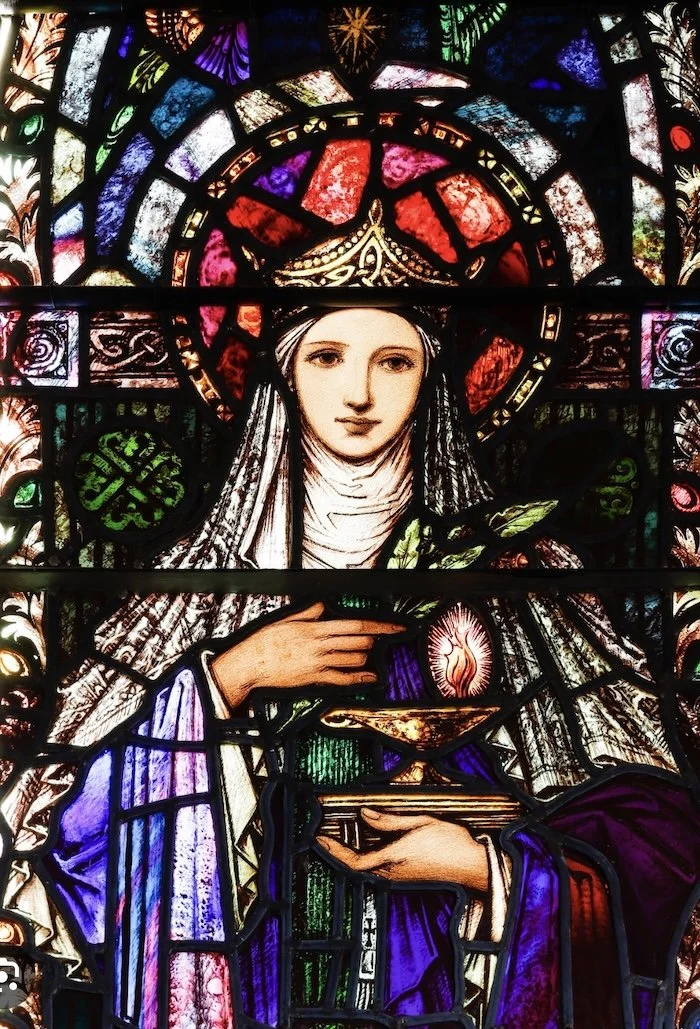
The 1933 east window at St. Mary of the Rosary Church in Cong, Co. Mayo, featuring St. Brigid, was created by Richard King for the Harry Clarke Studios. The window depicts the Holy Family, with smaller panels showing the Annunciation and Flight into Egypt.
St. Brigid of Kildare (Kildare comes from the Irish Cill Dara, meaning “church of the oak”) lived around 451 to 525 CE and became one of Ireland’s three patron saints. She founded a monastery at Kildare, and there are some interesting things to note regarding this. Her monastery kept a perpetual flame tended by 19 nuns (this number is connected to Celtic calendrical systems). Her feast day is February 1st, same as the goddess Brigid. Her monastery is built in connection with the oak tree, a tree sacred in Druidic tradition.
The stories told about St. Brigid in Catholic writings are striking because they echo the attributes of the goddess so closely. One famous story tells how Brigid asked a king for land to build her monastery. He mockingly said she could have as much land as her cloak could cover. She laid her cloak on the ground, and it miraculously expanded to cover acres of land. This mirrors the goddess Brigid’s connection to sovereignty and the land itself.
There are numerous stories of St. Brigid multiplying food and drink, turning water into ale, providing abundant butter and milk. These abundance miracles reflect the goddess’s association with fertility and sustenance, and Imbolc’s focus on the return of milk and nourishment.
One particularly telling story involves St. Brigid hanging her wet cloak on a sunbeam, which held it as if it were a solid beam. Fire and light imagery surround St. Brigid (just as they do the goddess Brigid) constantly. She’s often depicted with a perpetual flame. One account describes fire appearing above her head as an infant, yet nothing burned.
Stories tell of St. Brigid curing ailments, restoring sight, and having deep knowledge of herbs and healing waters. Her monastery at Kildare was built near a sacred well, and holy wells dedicated to Brigid (goddess or saint, it becomes hard to distinguish) are found throughout Ireland.
The transition from goddess to saint was smooth. Almost suspiciously smooth. The Christianity that came to Ireland didn’t try to erase Brigid. It absorbed her, transformed her, made space for her. This was likely a deliberate evangelization strategy, but it also suggests something important. Brigid’s power ran so deep that she couldn’t be eliminated. She could only be recontextualized.
That perpetual flame at Kildare? It burned until the 16th century. Over 1000 years. This was almost certainly a pre-Christian practice continued under Christian auspices. The fact that women tended it, that the site was at an oak grove, that there were 19 of them, all of this points to continuity rather than replacement.
Candlemas (a Christian feast day celebrated annually on February 2nd) is another example of early Christian syncretism, a clever strategy used to merge existing pagan “threshold times” such as Imbolc with Christian dates and beliefs to aid conversion efforts. By setting Candlemas on February 2nd, the Church directly overlapped with the ancient Celtic fire festival of Imbolc. Both holidays shared central themes of light returningand purification after winter’s darkness.
The Christian narrative of Christ as the “Light of the World” easily supplanted the pagan celebration of the goddess Brigid’s hearth fire and the sun’s return, transforming existing rituals into new, acceptable Christian practices. My mother’s ability to hold both St. Brigid and the goddess Brigid, both her Catholic upbringing and the older knowing that seasons turn according to rhythms deeper than doctrine, feels deeply connected to her ancestral wisdom.
This is a powerful reminder that the sacred persists by adapting. What is truly powerful in a spiritual tradition survives across cultural changes, across time, despite the efforts of the church.
Whether you connect with Brigid as goddess, as saint, or as both, you’re touching something that has guided people through liminal times for thousands of years. For those of us with lineages that extend to Celtic lands, it can feel like a homecoming to connect with Brigid by honoring her feast day of Imbolc. Chances are, she’s been connecting with you all along and you might not have noticed.
As I’m writing this, I’m not only remembering my mother’s teachings on Candlemas and Imbolc—I’m also recalling how in my teenage years I used to draw a tree against a pink and purple sky. That might not seem too compelling, but it was an oak tree, a symbol of druidic tradition and Brigid.
Fast forward to present day, where my home now stands beside a white oak tree. That might not seem too magical, except the tree looks exactly like the oak tree I used to repeatedly draw. Some mornings when I get up to let the dogs out the tree sits against a magnificent pink and purple sky. It is where my altar space to the goddess Brigid (and other nature spirits) now sits.
White oaks are protected where I live. They have declined to less than 10% of their historic range and support hundreds of wildlife species, they are critical to the landscape. Many Indigenous peoples traditionally managed them with fire (isn’t that interesting) and revered them as “trees of life” that provided vital medicine, spiritual centers for gathering, and a staple food source in acorns.
For me, this adds to the mysticism of my connection to Brigid and the oak tree. It’s a reminder to look for the sacred in all that surrounds you. And I tell you something, everyone who enters my garden, is drawn to the oak tree. Not just for it’s beauty, thought that’s part of it. I think it is for it’s magic. Maybe they have their own unconscious connection to a sacred deity they can no longer name, just like I did.
How Brigid guides us at Imbolc:
Brigid’s three aspects give us a framework for this time:
Poetry and Inspiration: Imbolc is a time to listen to what wants to be born through you creatively. Not to force it, but to be receptive to it. What’s quickening in the belly of your creative life?
Healing: This time of increasing light invites us to tend to what needs mending. If you’re doing shadow work, if you’re in therapy, if you’re working with your ancestors, Imbolc offers supportive energy for that deep healing work.
Smithcraft: The forge is a powerful metaphor for transformation. What needs to be melted down and recast in your life? What old forms need to break apart so something new can take shape?
Brigid’s connection to hearth and home reminds us that this isn’t about grand ritual. It’s about daily tending of the sacred flame, whether that’s literal or metaphorical. It’s about the magic of showing up, day after day, to tend what matters.
Her association with liminality (thresholds, dawn, Imbolc itself as a between-time) invites us to honor transitions rather than rushing through them. We’re between death and rebirth right now. The earth knows this. Your body knows this. Brigid knows this.
I have written a poem, inspired by Brigid and her flame, for you to engage during yourself care and spiritual practices this Imbolc. I wonder what magic, what illumination will come to you from engaging not only Brigid’s flame, but yours.
Tending the Flame
The sacred flame within you
began as a spark—
a first breath,
a shock of love and life
entering your small heart
when you exited the womb,
to enter this world.
It was yours then.
It is yours now.
Yours to tend.
Fire is mighty
but it can be put out.
Harsh words. Cruelty.
Pain. Grief.
Suffering that seems
like it will never end.
These things can extinguish you.
Or, and this is the mystery,
these things can become fuel.
The question is not
whether your flame will dim.
It will. We are human.
We are made of elements
that ebb and flow.
The question is—
can you feel into
what your fire is telling you?
It might be saying I’m dimming. I’m lost. I’m alone.
It might be saying I’m raging. I’m wild. I’m a destroyer.
These are all holy.
These are all facets
of the sacred, primal elements
of your nature.
Fire teaches by burning.
It teaches what can be consumed
and what remains.
It teaches that destruction
is sometimes the path to warmth,
that rage can be
the beginning of clarity,
that the wild flame knows something
the tame one has forgotten.
To tend your flame
is not to make it behave.
It is to listen.
To feel into the heat of it,
the hunger of it,
what it is asking for,
what it is trying to tell you
about how you need to live.
When it dims,
you do not scold it.
You bring it oxygen.
You bring it rest.
You bring it the fuel
of beauty, of laughter,
of being seen.
You give it permission to burn
the way it needs to burn.
When it rages,
you do not fear it.
You ask what it’s trying
to destroy in you
that needs destroying—
what old wood,
what dead weight,
what structure built
by someone else’s hands,
needs to burn,
to cinder and ash.
For a thousand years women tended Brigid’s flame at Kildare, and it never went out. Not because they forced it. Not because they controlled it. But because they listened. Because they showed up, again and again, in the dark, in the doubt, and asked: What does the fire need today?
Your life is like this.
The spark you were born with wants to become the flame that lights your way.
But it needs you to pay attention. To feel into its language. To honor both its dimming and its wildness as sacred instruction.
You are the keeper of your own fire. Not its master.
You are the one who must do the tending,
and the witnessing.
You are its faithful companion
through all the seasons
of burning.
You are the fire
that lights
your way.
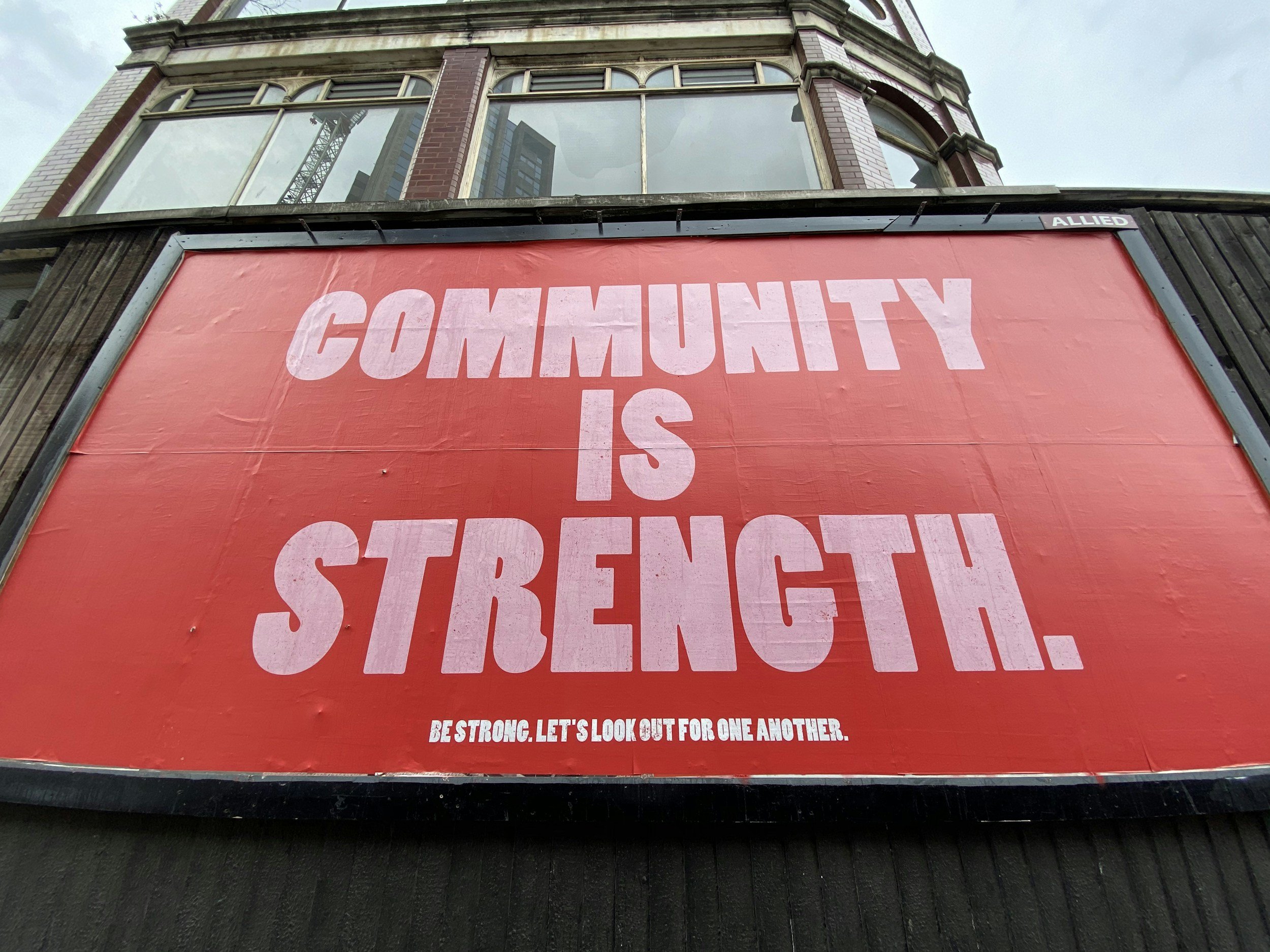
A Note on Community
I want to acknowledge what’s happening with ICE operations in the United States (Turtle Island) and how we can help. I see this as part of tending my inner flame and that of my community members.
What’s happening: Nationally, 73,000 people are detained by ICE (the highest ever), and 73.6% have no criminal conviction. Over 3,800 children have been detained this year. There have been at least 8 fatal shootings by immigration agents since January 2025. Right here in Clark County, WA (where I live), people are being arrested at the courthouse, during traffic stops, and while complying with legal check-ins. I have heard reports of community members going to their local markets and disappearing. One of these was a 76 year old woman.
On whose land we’re (I’m) on: No one is illegal on stolen land. I live on the traditional territory of the Confederated Tribes of Siletz Indians, the Confederated Tribes of Grand Ronde, the Cayuse, Umatilla and Walla Walla peoples, the Chinook, and the Stl’pulmsh (Cowlitz) people.
LANDBACK is the Indigenous-led movement to return land stewardship and decision-making to Indigenous nations, focusing on public lands and treaty rights, not removing homeowners.
How we show up for neighbors is part of living in reciprocity with this land.
Indigenous rights and our rights are deeply connected. Both are rooted in the fundamental principle that all people have inherent dignity and belong to the land they inhabit, not as property owners under colonial legal systems, but as communities living in relationship with place. When we accept the premise that some people are "illegal" on stolen land, we're upholding the same colonial logic that justified dispossessing Indigenous peoples from their territories.
The mechanisms of forced removal, family separation, detention without due process, and the denial of sovereignty that Indigenous peoples have faced for centuries are the same tools being used against immigrant communities today. Both struggles challenge the white supremacist nation-state's power to determine who belongs and who can be erased. We can't dismantle ICE's cages without also supporting LANDBACK, because they're both fights against the same apparatus of state violence and control.
On allyship (especially for white and white-passing folks): To be helpful rather than harmful requires lifelong commitment to self-education, centering the voices and leadership of people of color, and taking action to dismantle systemic oppression without seeking praise or acting as a savior.
Key practices: acknowledge your privilege, take responsibility for your own learning (it’s not their job to educate you), listen deeply to BIPOC experiences and priorities, practice humility when called out, use your privilege to create change, provide tangible support through donations and votes, and build authentic relationships by joining existing anti-racist work.
Where to start: I’m not a lover of social media, but for organizing and connecting with community activists and organizations like LULAC (League of United Latin American Citizens), it’s been a helpful tool. Using it intentionally helps us align our actions to support folks who need us to show up in ways that don’t cause further harm.
Southwest Washington LULAC’s Facebook page has been effective for this. They support detained community members, share practical guidance, and do direct protection work. My local chapter has been clear about how to help, and they’re working hard right now.
If you live in the United States, find out what your local LULAC chapter is, learn how they’re showing up in your community, learn what support they’re asking for, and donate to them.
Facebook: https://facebook.com/SWWALULAC
Website: https://lulacvancouver.org
Engaging with spiritual content isn’t about bypassing reality. It’s about building the resilience and connection we need to face it. Ritual and honoring Brigid’s wisdom sustains us so we can sustain each other. I hope that the content I create helps you in your self care and spiritual practices so you can then not only support YOU but your COMMUNITY.
Journal Prompts for Self Evaluation
Journal Prompt 1: Land and Belonging
I live on the traditional territory of [fill in your local Indigenous peoples]. Find whose land your on here.
When I think about the idea that “no one is illegal on stolen land,” what feelings come up for me?
What have I been taught about who belongs here and who doesn’t? Where did those beliefs come from?
In what specific ways do I benefit from being on this land today? If I sat with the fact that this land was never ceded, how might that change how I think about borders and immigration?
How does acknowledging the history of this land influence my sense of responsibility toward those currently seeking a home here?
Journal Prompt 2: Fear and Safety
When I think about ICE operations in my community, what am I actually afraid of?
What do I believe keeps me and my family safe? Have I ever personally been harmed by an undocumented person, or is my fear based on what I’ve been told to fear?
If 73% of people being detained have no criminal record and were working and paying taxes, what does that tell me about what’s really happening?
What would true safety look like in my community? Who is currently excluded from that vision of safety, and what would it take to include them?
If I define safety as mutual care and stability, how does the threat of deportation affect the collective safety of my neighborhood?
Journal Prompt 3: Neighbor or Stranger
Think of the people in your life—your coworkers, the person who serves your coffee, parents at your kid’s school, people at the grocery store.
How many of them do you actually know their immigration status? If you found out tomorrow that someone you interact with regularly was undocumented, would that change how you see them?
What does it mean to be a good neighbor? Does that change based on paperwork?
Has my definition of a “good neighbor” ever required someone to prove their “right” to be here before I offered them kindness or support?
How can I use my own values—like family, hard work, or fairness—to see the humanity in a neighbor whose legal status is different from mine?